
The Role of the Narrator in Charles Dickens’ A Christmas Carol (GCSE English)
If you ask someone to list the main characters in Charles Dickens’ novella, A Christmas Carol, there’s a good chance you’ll hear familiar names like Ebenezer Scrooge, Marley’s ghost, Bob Cratchit and his family, and, of course, the Ghosts of Christmas Past, Present, and Yet To Come. However, there is one player that is often overlooked; a voice present throughout the story, guiding the reader and acting as a bridge between their world and Dickens’ fictional one. That voice belongs to the narrator.
In this article, our expert tutor and resident Christmas Carol enthusiast, Ben Huntley, will explain how the narrator is one of the most important roles in Scrooge’s story. Analysing how Dickens uses the narrator’s voice in A Christmas Carol is a fantastic way to access those top marks in your English Literature GCSE exam. Before we begin, let’s review the different types of narrators in literature.
What is a Narrator?
The narrator is the voice an author adopts to tell a story. Sometimes the narrator will be a character within the story, and we travel through the events from their perspective. This is called a first-person narrator. Choosing a first-person narration style allows the reader greater insight into a specific character and intimately immerses them in the story, but restricts knowledge to what that one character experiences. Another Dickens novel, Great Expectations, is an example of this. The main character, Pip, narrates his life as the story progresses from childhood to adulthood.
A third-person limited narrator uses third-person (he/she/they) but still follows a single character. The Harry Potter book series is an example of this technique. The narrator follows Harry, and the reader learns and explores the world alongside him, while the other characters share details that Harry and the reader need to be told. Again, this gives greater insight into a single character’s experience, but restricts our perspective.
A third-person omniscient narrator is a voice that knows everything. They have a bird’s-eye view of events and can reveal the thoughts and feelings of multiple characters, creating a more rounded version of the story.
The narrator in A Christmas Carol falls into the third-person omniscient category. Throughout the book, although primarily following Scrooge, the narrator tells the reader what each character is experiencing, notably in the Christmas dinner sequence at the Cratchits’ in Stave Three.
(Bonus fun fact: The Muppet Christmas Carol cheekily references this style of narration when Rizzo the Rat asks Gonzo, the narrator in the film, “How do you know what Scrooge is doing? We’re down here, and he’s up there.” To which Gonzo replies: “I keep telling you. Storytellers are omniscient. We know everything.”)
However, the Christmas Carol narrator acts as more than just an observer. It directly addresses the reader on numerous occasions, guiding our moral interpretation of the story. We’ll now take a deeper dive into how Dickens uses the narrator throughout the novella, beginning with how the story opens.
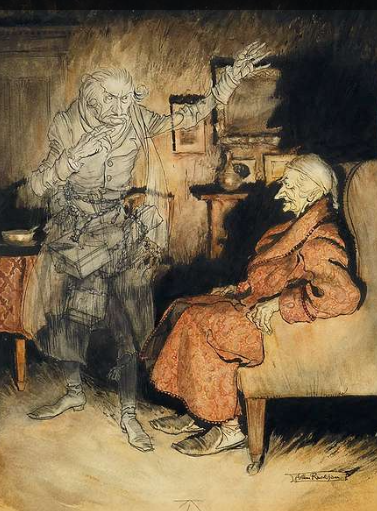
‘Scrooge and the Ghost of Marley' by Arthur Rackham
“Marley was dead: to begin with.”
This is one of the most famous opening lines in English literature. The paragraph ends with the simile that Marley was “as dead as a doornail.” The juxtaposition of beginning a book with the finality of death is intriguing and raises many questions for the reader: Who is Marley? When did he die? How does this impact the story?
However, it is after this curious opening that we are given the first clues that the narrator of this story is not a typical one. Have a read of this extract and see if you can spot anything unusual:
“Mind! I don’t mean to say that I know, of my own knowledge, what there is particularly dead about a door-nail. I might have been inclined, myself, to regard a coffin-nail as the deadest piece of ironmongery in the trade. But the wisdom of our ancestors is in the simile; and my unhallowed hands shall not disturb it, or the Country’s done for. You will therefore permit me to repeat, emphatically, that Marley was as dead as a door-nail.”
If this is a third-person omniscient narrator, why does it shift into the first person? Not only that, but the narrator adopts a humorous, self-aware tone, commenting on the various degrees of “deadness” in metalwork and even justifying why the specific simile “dead as a doornail” has been chosen. The narrator also claims to have no choice in the matter, presenting itself as bound by tradition: this is the simile, and therefore it must be used. Most strikingly, the narrator then breaks the narrative frame altogether by directly addressing the reader: “You will therefore permit me …”
In this short paragraph, the specific character of this narrator is established. It presents as thoughtful (discussing the various possible similes), honest (explaining that a different phrase would be better), self-aware (communicating directly with the reader), and, crucially, dutiful (sharing its obligation to tell the reader the story exactly as it should be, without any alterations). As a result, we, as readers, trust the narrator to guide us through the rest of the story, believing everything we are presented with as being true.
Scrooge: “Solitary as an oyster.”
Why does this matter? Well, just a couple of paragraphs later, we are introduced to Scrooge for the first time. When you read this extract, what is the feeling you get about him as a character? What language choices has the narrator used to show you who Scrooge is?
“Oh! But he was a tight-fisted hand at the grindstone, Scrooge! a squeezing, wrenching, grasping, scraping, clutching, covetous, old sinner! Hard and sharp as flint, from which no steel had ever struck out generous fire; secret, and self-contained, and solitary as an oyster. The cold within him froze his old features, nipped his pointed nose, shrivelled his cheek, stiffened his gait; made his eyes red, his thin lips blue; and spoke out shrewdly in his grating voice. A frosty rime was on his head, and on his eyebrows, and his wiry chin. He carried his own low temperature always about with him; he iced his office in the dog-days; and didn’t thaw it one degree at Christmas.”
The overwhelming inference created in this extract is that Scrooge is cold. Look at all the words from the semantic field of cold temperature: steel, froze, nipped, blue, frosty, iced, and so on. From this starting point, we find other language features that emphasise this frostiness. He is “hard and sharp,” incapable of creating any warmth. He is “solitary as an oyster,” totally self-contained within his own hard exterior. The extended metaphor of the surrounding temperature changing to suit Scrooge’s temperament serves to highlight this: not only does he keep himself cold, he also spreads the chill, metaphorically and literally, sucking joy and light out of otherwise happy times, the “dog-days” of summer, the hottest days of the year.
This is why the narrator is so crucial in A Christmas Carol. The narrator is in charge of the reader’s feelings at this stage. Not only has it established itself as a trustworthy voice , but it categorically states that, at this stage, Scrooge is an unpleasant character, completely void of warmth and human affection.
However, it also subtly hints at the story’s moralising nature. Think back to the simile “solitary as an oyster.” Yes, this emphasises Scrooge’s selfish nature and hard exterior, but what do oysters contain within them? The narrator is hinting that, within Scrooge, there may be a pearl of goodness waiting to emerge. This idea of potential redemption is strengthened shortly after when the narrator uses the phrase “Once upon a time” to begin the plot. The reader is now prepared for a moral fairytale.
By combining vivid imagery with a morally guiding voice, Dickens solidifies A Christmas Carol as a tale of transformation and redemption, with Scrooge firmly established as its flawed, yet promising, protagonist.
Example Exam Question
Understanding the significance of the narrator in A Christmas Carol is an important first step, but how can we best utilise this knowledge in a GCSE English Literature exam? Below is a short extract from a past paper, followed by the question that accompanies it. Read through the extract and the question, then we’ll explore how language analysis of the narrator can help to access those higher marks.
In this extract, the Ghost of Christmas Past walks Scrooge through a memory of the Christmas party he attended at Mr Fezziwig’s warehouse when he was a young man.
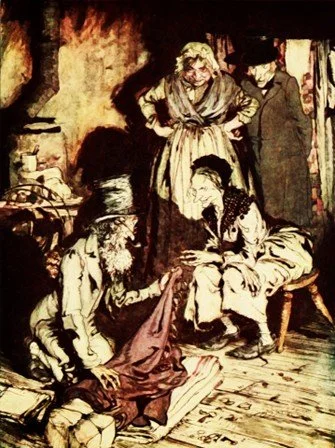
Vintage illustration from the novel by Charles Dickens.
“But if they had been twice as many—ah, four times—old Fezziwig would have been a match for them, and so would Mrs. Fezziwig. As to her, she was worthy to be his partner in every sense of the term. If that’s not high praise, tell me higher, and I’ll use it. A positive light appeared to issue from Fezziwig’s calves. They shone in every part of the dance like moons. You couldn’t have predicted, at any given time, what would have become of them next. And when old Fezziwig and Mrs. Fezziwig had gone all through the dance; advance and retire, both hands to your partner, bow and curtsey, corkscrew, thread-the-needle, and back again to your place; Fezziwig “cut”—cut so deftly, that he appeared to wink with his legs, and came upon his feet again without a stagger.
When the clock struck eleven, this domestic ball broke up. Mr. and Mrs. Fezziwig took their stations, one on either side of the door, and shaking hands with every person individually as he or she went out, wished him or her a Merry Christmas. When everybody had retired but the two ’prentices, they did the same to them; and thus the cheerful voices died away, and the lads were left to their beds; which were under a counter in the back-shop.
During the whole of this time, Scrooge had acted like a man out of his wits. His heart and soul were in the scene, and with his former self. He corroborated everything, remembered everything, enjoyed everything, and underwent the strangest agitation. It was not until now, when the bright faces of his former self and Dick were turned from them, that he remembered the Ghost, and became conscious that it was looking full upon him, while the light upon its head burnt very clear.”
Starting with this extract, explore how Dickens presents ideas about joy and happiness in A Christmas Carol.
Here is an example of how we can use the narrator in our answer to access those higher-level marks.
One way Dickens presents ideas about joy and happiness is through the narrator’s voice. Notice how different the language is here compared with the initial description of Scrooge. In contrast to the chill emitting from Scrooge, there is “a positive light” radiating from Fezziwig’s legs, which appear to “wink,” a light-hearted gesture with connotations of fun and playfulness. Similarly, the language of dancing, “corkscrew, thread-the-needle,” and so on, gives strong connotations of celebration and joy.
Once again, the narrator directly addresses the reader, asking them to “tell me higher” praise, emphasising that there is nothing the narrator can say about the Fezziwigs that would be too exaggerated. The narrator is describing the scene to the best of their ability, leading us as readers to trust the narrator’s voice. The narrator’s descriptions don’t just depict joy; they invite us to share in it and see the value of generosity, reinforcing Dickens’ moral message.
The narrator’s omniscience (all-knowing nature) also explores joy and happiness by providing multiple perspectives. Look again at what is being focused on in each paragraph. The first two comprise a rich description of the party and its conclusion. In the third paragraph, the narrator refocuses our attention on Scrooge to demonstrate the effect this joviality is having on him. Notice how different it is from the description at the start of the story. This cold, hard man is now giving his “heart and soul” to the vibrant scene. Remember, this is a moralising story about redemption and Scrooge changing his ways. This is one of the first examples of Scrooge, “solitary as an oyster,” opening himself up and allowing connection and warmth back into his life.
Why This Works
This is a top-notch way to frame your answer to the question. It gives detailed insight into the extract itself and concisely links to other areas of the story. It scores well on all of the major assessment objectives, and here’s how:
AO1: Read, understand and respond to texts - this answer shows that we know the story and how this extract links to other areas of the novella.
AO2: Analyse the language, form and structure used by a writer to create meanings and effects - the analysis of the language used demonstrates an in-depth understanding of how the language works to create effects and explore ideas.
AO3: Show understanding of the relationships between texts and the contexts in which they were written - by referencing the moralising nature of the text, we create opportunities to discuss the ideas prevalent at the time of the novella and Dickens’s intentions. We can explain that Dickens aimed to appeal to the Victorian middle class by encouraging them to sympathise with the plight of the poor, who were often blamed for their circumstances and confined to workhouses. Or we can explore how the narrator encourages Christian ideas about happiness and human kindness.
“God bless Us, Every One!”: closing remarks
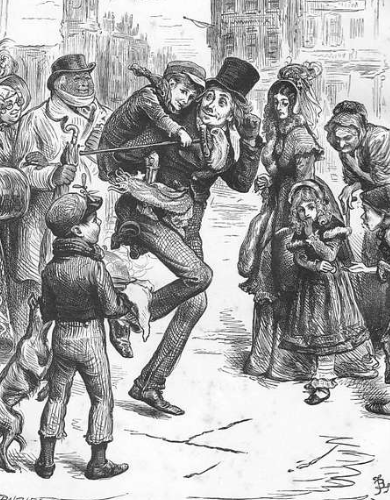
A book illustration of Bob Cratchit and his son Tim.
The narrator has the last words in the novella: “And so, as Tiny Tim observed, God bless Us, Every One!” With this closing remark, the narrator sums up their role. The narrator is on the reader’s side, acting as a force for good within the story. The narrator is also omniscient, knowing everything from “Marley was dead” at the beginning to how Tiny Tim would sum up the story.
Analysing the language of the narrator demonstrates an understanding of the extract given in your exam, as well as broader themes in the novella.
Remember:
Analyse the language used by the narrator in the extract you’re given.
Explore how that helps to answer the specific question in front of you.
Compare this language to other parts in the novella and think about why there are similarities or differences.
If you consider the narrator as a main character in A Christmas Carol, it allows you to access a higher level of analysis, which is a crucial step in achieving those higher marks in your exam.
