
How to Master the 12-Marker in Religious Studies (RS) GCSE
The 12-mark evaluation question is the greatest challenge of your Religious Studies GCSE. It is the single biggest differentiator between a "safe" Grade 5 and those elusive Grades 8 and 9.
You may know your quotes and your definitions, but R.S isn't just about knowing facts— it’s about the art of the argument. To hit the top marks, you need to think fast, write fast, and use the right tools to dismantle tricky questions.
Here is your battle plan to move from a basic level to a top-tier scholar.
1. The Golden Rule: Timing is Everything
The most common feedback from top students? "I ran out of time."
You have roughly 15 minutes for this question. The rule of thumb is one minute per mark, plus a little buffer. You cannot afford to meander; you need a strict strategy that you try and test over time.
The 15-Minute Breakdown
Minute 1: The Mini-Plan (Critical)
Do not skip this. Spend 60 seconds scribbling a short "For and Against" table.
-Why? It prevents the dreaded "mind blank" halfway through the essay.
-Scrap paper example: "Love vs Justice. Sheep/Goats parable. Inconsistent Triad. Reformation view."
Minute 2: The Setup (Micro-Intro)
Keep this brief. A clear opening sentence signals to the examiner that you are in control.
Minutes 3–7: The "For" Side
Effectively 5 minutes. Write as many detailed paragraphs as you can fit using the structures below.
Minutes 8–12: The "Against" Side
Another 5 minutes to argue the converse.
Minutes 13–15: The Verdict
Use your final minutes to write a justified conclusion. This is where the marks are hidden.
Emergency Tip: If you have 3 minutes left and haven't written a conclusion, stop writing your paragraph immediately. A conclusion is worth more marks than finishing a half-done point. Skip a line and write the conclusion.
It might also be that you have gone through the shorter questions quickly and freed up more time. If this is the case, divide the additional time equally between each side of the argument and conclusion. You should aim to be asking for more paper and surpassing the allotted lines on both sides of the answer booklet.
2. The Strategy: Speed vs. Detail
The "Micro-Intro"
Feedback suggests students waste time on long introductions. The solution is the Micro-Intro. You don't need a paragraph; you need a headline. Indicate your strongest argument immediately to gain "coherence" marks.
The Template:
"While some [Religious Group] might argue [Point A], the strongest argument is undoubtedly [Point B] because it aligns best with [Key Belief/Scripture]."
The Secret Sauce: P.A.S.T.A. Paragraphs
Forget PEEL. It’s too basic for a 12-marker. If you want a structure that guarantees appraisal and analysis, switch to P.A.S.T.A. (it will impress the examiner more).
P – Point: Make a clear, bold statement linked to the question.
A – Authority: Insert your SOWA (Source of Wisdom and Authority) or a link to religious teachings.
S – So What? (Analysis): How does this change a believer’s life? Give several connected reasons here.
T – Tension (Appraisal): The clever bit. Is this argument strong? Does it make sense? Does it clash with another teaching?
A – Answer: Link back to your "intent"—does this prove or disprove the statement, and why?
Sticking the Landing: The PIE Conclusion
Your conclusion should never simply repeat your points. It needs to deliver a verdict.
P – Personal/Pragmatic: Does the argument make sense in the modern world? Is it intuitive?
I – Internal Logic: Does it work inside the religion? (e.g., "If God is just, this must happen...") What would different Muslims, Christians, Buddhists, etc., think about the argument?
E – External Factors: Do secular views or other denominations, scientists, scholars, etc., weaken the argument?
3. Developing a "Chain of Reasoning"
Top-tier answers create a flow. Regardless of the religion, try to link these four concepts in your paragraphs to automatically boost your complexity.
God: What nature of God is involved? (e.g., Omnipotence, Tawhid, Adalat).
The Holy Text: What does the Bible or Qur'an command?
The Founder: How did Jesus or Muhammad model this?
Judgement: What are the eternal consequences (Heaven/Hell/Akhirah)?
Worked Example (Christianity):
"Christians oppose crime because they believe in a Just God (1). This justice is codified in the Bible, which warns that God will separate the 'Sheep from the Goats' (2). Jesus modelled forgiveness, but he also warned of consequences (3). Therefore, a Christian avoids sin not just to be 'good', but to ensure they reach Heaven and avoid Hell (4)."
4. Level Up Your Vocabulary
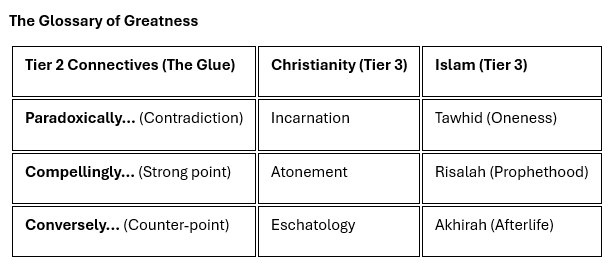
To write like a scholar, use more “Tier 2” connectives to introduce more "Tier 3" (specialist) language and "Power Verbs" to show analysis.
Evaluative Power Verbs:
Instead of "This shows that...", try: "This exposes a flaw in..."
Instead of "This says...", try: "This reinforces the idea that...", or "This undermines the view that...”
5. Walkthrough: Full Model Answers
Below are examples of how to apply the Micro-Intro, P.A.S.T.A,and PIE methods in real time.
☪️ Example A: Islam
Statement: "Fasting should be an individual choice, not compulsory."
(Micro-Intro)
While liberal Muslim perspectives might argue fasting should be a personal choice to avoid hardship, the strongest argument is that fasting must remain compulsory. This is because it is a fundamental Pillar of Islam (Fard) commanded by Allah to ensure spiritual growth, not just a lifestyle choice.
(Paragraph 1: P.A.S.T.A - Against the Statement)
[Point] Fundamentally, most Muslims argue that fasting cannot be a choice because it is one of the Five Pillars of Islam, making it an absolute duty (Fard). [Authority] This is explicitly commanded in the Qur'an (Surah 2:183): "Fasting is prescribed for you... that you may develop Taqwa." [So What?] This establishes a clear chain of logic: Allah demands obedience. By fasting, a Muslim develops Taqwa (God-consciousness). If it were merely a choice, many would abandon it due to weakness, risking their reward in the Akhirah (Afterlife). [Tension] While some argue this is difficult, the internal logic is that submission defines a Muslim; you cannot pick and choose commands. [Answer] Therefore, the statement is weak because perceiving fasting as optional undermines the authority of the Qur'an.
(Conclusion: PIE)
[Personal] Personally, I conclude that the statement is incorrect. If fasting were an individual choice, the communal unity of Ramadan would collapse. [Internal] Internally, the logic of Islam is based on submission. To make a Pillar optional is a contradiction; it implies human comfort is superior to Divine command. [External] Externally, while secular society values autonomy, in a religious framework, discipline allows for spiritual freedom. Therefore, fasting must remain compulsory.
✝️ Example B: Christianity
Statement:"For a Christian, the most important belief is that Jesus died to save people from sin."
(Micro-Intro)
While the Atonement is the mechanism that deals with sin, I will argue that the statement is too limited. The Resurrection is arguably the most important belief because, without the victory over death, the crucifixion would merely be the tragic execution of a martyr.
(Paragraph 1: P.A.S.T.A - For the Statement)
[Point] Compellingly, many Christians (particularly Evangelicals) argue that Jesus' death is the most important event because it achieves Atonement. [Authority] This is underpinned by John 3:16 and St Paul’s teaching that "Christ died for our sins." [So What?] This solves the "Chain of Reasoning" regarding separation from God. God is Just; therefore, the debt of Original Sin had to be paid. Without this sacrifice, the "bridge" to Heaven remains broken. [Tension] This argument is strong because it balances God’s Omnibenevolence (Love) with His Divine Justice. [Answer] Therefore, if the goal is Salvation, death is the necessary payment to achieve it.
(Paragraph 2: P.A.S.T.A - Against the Statement)
[Point] Conversely, many Christian theologians (people who study religion) argue that the Resurrection is the most important belief. [Authority] St Paul explicitly states in 1 Corinthians 15: "And if Christ has not been raised, your faith is futile." [So What?] This shifts the focus to God's Omnipotence. If Jesus stayed dead, he was just a man. The Resurrection proves his Divinity. [Tension] This exposes a flaw in the original statement: a dead saviour cannot save anyone. The death deals with the past, but the Resurrection guarantees the future. [Answer] Consequently, Jesus’ death is meaningless without the Resurrection.
(Conclusion: PIE)
[Personal] Personally, attempting to rank these beliefs creates a false dichotomy; they are two sides of the same coin. [Internal] However, looking at the Internal logic, the Resurrection acts as the "receipt" that the payment for sin was accepted. Without the receipt, there can be no assurance. [External] Externally, critics might argue a loving God shouldn't require a blood sacrifice, rendering the Resurrection a more inspiring concept. Therefore, the statement is only partially true, and the Resurrection is the ultimate cornerstone.
6. Common Pitfalls
Even high-grade students lose marks to these traps.
The "Fence Sitter": Do not conclude with "Everyone has their own opinion, so we will never know." The examiner wants your judgement based on evidence. Pick a side!
The "Generic God": Don't just say "God." Say "The Trinity," "The Father," "Allah," or "Tawhid." Specificity gets marks; vague "religious feeling" does not.
Ignoring the "Tension": A Grade 5 answer gives the argument. A Grade 9 answer gives the argument and then critiques it. Always ask: "Is this argument actually good?"
Your Revision Task
Ask your teacher for three "Classic 12-mark statements."
Always use timers at home and write for 15 minutes.
Practice some short, snappy trial runs of a 1-minute plan, the P.A.S.T.A. paragraphs, and the PIE conclusion.
